Gaussian Process Implicit Surfaces as Participating Media:
Realization-Free Rendering from Level-Crossing Statistics
Abstract
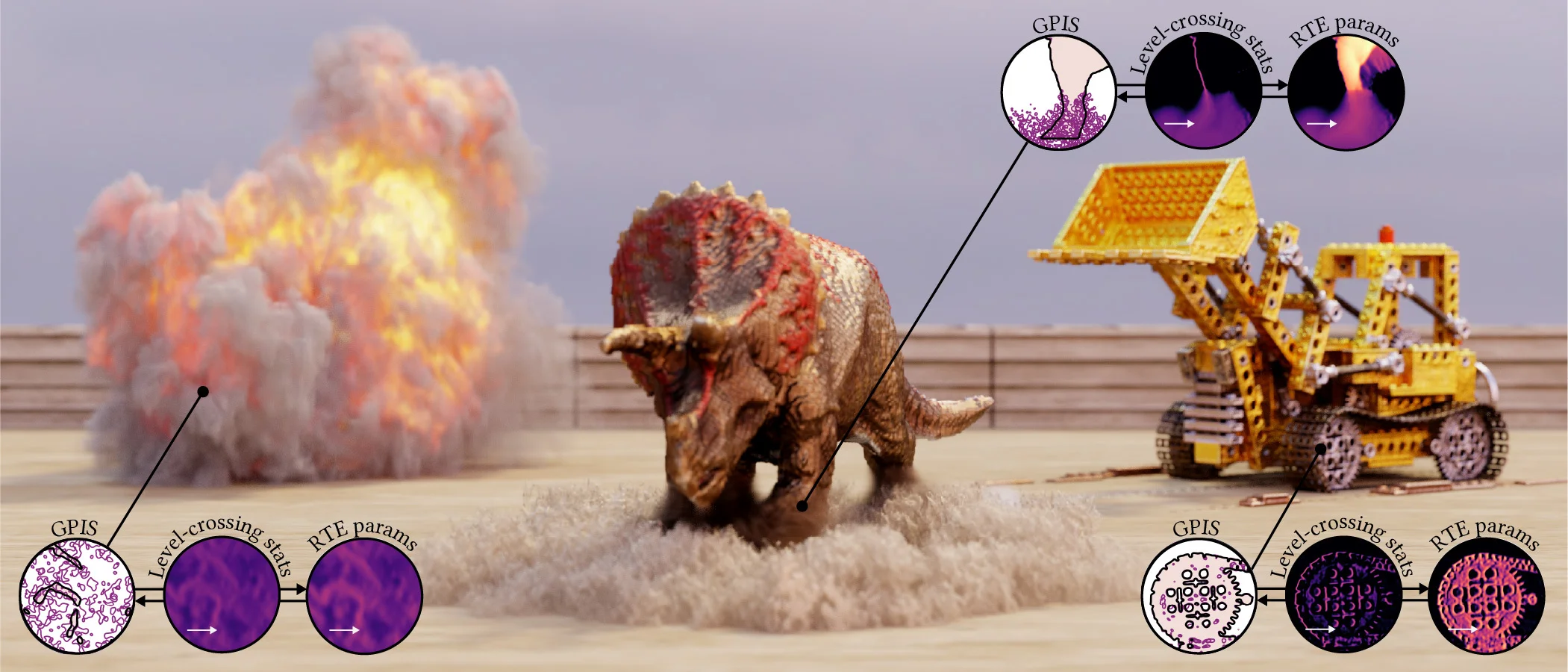
We present a theory of light scattering that connects Gaussian Process Implicit Surfaces (GPISes) and participating media in both directions. Applying the Kac–Rice level-crossing formula under a local-conditioning approximation yields a complete anisotropic radiative transfer equation (RTE) directly from pointwise GPIS statistics. A shared projected area couples extinction and scattering, ensuring geometric consistency between the GPIS and its volumetric representation. The framework spans rough surfaces, porous and non-height-field geometries, and participating media. From the same statistical structure, we derive full-sphere Beckmann and GGX normal distribution functions supporting in-plane and out-of-plane anisotropy. These families provably recover SGGX, Beckmann, and GGX as special cases and admit exact visible-normal importance sampling. We also derive analytic masking–shadowing functions and single-scattering surface models for specular microsurfaces, with extensions to multiple scattering. In the height-field limit, we prove that the local-conditioning approximation reduces to Smith's independence assumption. Our realization-free approach improves rendering efficiency over realization-based methods and can be implemented within a standard volume renderer. In the inverse direction, we characterize families of GPISes corresponding to compatible RTE parameters and develop practical lifts for heterogeneous density fields. Existing volumetric assets thereby become renderable as GPISes, while trained radiance-field reconstructions yield surface geometry and shading normals without mesh extraction and provide a density-based representation of geometric uncertainty.
BibTeX
@misc{cui2026gpis,
  title         = {Gaussian Process Implicit Surfaces as Participating Media: Realization-Free Rendering from Level-Crossing Statistics},
  author        = {Cui, Jack and Xu, Kehan and d'Eon, Eugene and Jarosz, Wojciech},
  year          = {2026},
  eprint        = {2609.14695},
  archivePrefix = {arXiv},
  primaryClass  = {cs.GR},
  url           = {https://arxiv.org/abs/2609.14695},
}